From the 2026 Spring Journal of the Colorado Dental Association
Treating Aging Generations By Becky O’Guin, CDA Director of Communications
As more Coloradans age and develop Alzheimer’s disease or other dementias, learning to care for this vulnerable population is important.
The state population of ages 65 years and over increased by 30,000 between 2023 and 2024, according to the Colorado State Demography Office. While this growth is primarily due to Colorado residents aging rather than older adults moving to the state, this age group will continue to increase by 31% through 2030 with those aged 75 to 85 seeing the strongest future growth. The Alzheimer’s Association states that the most recent data shows more than 91,000 people aged 65 and older in Colorado are living with Alzheimer’s. With this growth in the senior population, it’s likely your dental practice will encounter some of these patients; caring for them takes more time and patience.
CDA member Dr. Lindsay Compton began working with elderly patients during dental school and in her general practice residency (GPR) at Truman Medical Center in Lakewood.
By the time she bought her practice, she had years of experience working with patients with dementia and other special needs. Dr. Compton said caregivers appreciate it when you care for their patients with an “I’m willing to try” attitude. “I think sometimes people are intimidated when they see somebody who has dementia or they are using a walker or are in a wheelchair they just want somebody to try, and they are not mad if you try and it doesn’t work.”
CDA member Dr. Katherine Sislow did a GPR at the University of Iowa Hospitals and
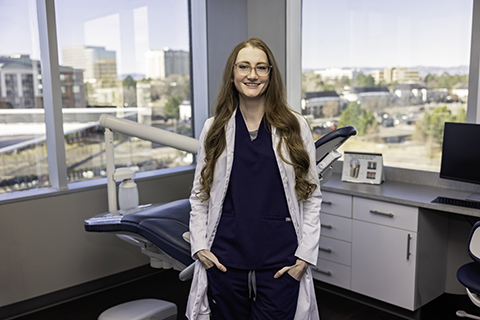
Dr. Katherine Sislow
Clinics where she treated elderly patients and now has a family practice that sees many aging and elderly patients.
Dr. Sislow said the main thing she recommends is to show compassion and try not to get frustrated. Some of the early signs of dementia in patients may be a long-time patient who shows up and doesn’t remember the front desk staff member or hygienist even though they have seen them many times over the years. You don’t always have confirmation of a dementia diagnosis from the caregiver or in the patient’s record, but there are signs if you look for them, Dr. Sislow said.
Both Drs. Compton and Sislow said that you must schedule more time with dementia patients. Allowing more time for the appointment can reduce frustration for the dentist and staff. It may be best to see them at a time when the office isn’t as busy so they don’t have to process a lot of different people coming and going. They also may need more time to fill out paperwork and get questions answered.
When it comes to treating patients with dementia, silence may not be golden. Dr. Compton tries to keep a stream of steady conversation going with the caregiver or her assistant so patients don’t have time to wonder where they are or what is happening during treatment. Dr. Sislow says it helps to have a television on in the room with a program they are familiar with, such as MASH, to distract them. A calm demeanor and going along with whatever they say is crucial for their mental comfort. It is possible they could ask the same question over and over and it’s best just to answer the question again and again.
“If you sit there and say things like, “well as I’ve already told you” or “like we’ve already discussed” then they feel very defensive and angry because it triggers the fear that they are losing something,” Dr. Sislow said. She added that using a show, tell, do method can be effective as well. “This is my mirror; it’s going to help me look at your teeth.”
Having a caregiver at the appointment is important so the patient has someone they are comfortable with. The caregiver can discuss what’s being done at home, help with treatment decisions, and provide a list of medications and contact information for the patient’s primary care physician.
“Whether you have dementia or not, the dental office isn’t the most comfortable place,” Dr. Compton said. “If they have a friendly face there, then it helps them be like, okay, this person who I trust is putting me in the care with a stranger, but since I trust them, this must be OK.”
It helps to be prepared for patients who may have a legal guardian or someone with medical power of attorney. It is important for the legal guardian to provide documentation of the patient’s status and their guardianship. Dr. Sislow said her office uses to assess the level of dementia before the patient comes into the office. For example, if an adult child or spouse calls, the dental office asks if they have legal guardianship and requests they bring documentation when they come in for an appointment. If the patient calls, the office may ask, “do you normally sign for yourself for treatment” or “who normally handles the finances for you” or “is there someone you trust that you would like to bring to your appointment?”
“We ask a couple of general questions about what level they are at, because dementia has levels,” she said. “You have plenty of those patients with just mild memory issues or cognitive decline, where they aren’t driving anymore and can still be themselves. They can feed themselves and they can hold a conversation. Then we have the other end of the spectrum where they are practically nonverbal.”
In addition, it may be best to treat that first appointment as a “get to know you” to gauge if the patient can be comfortable with an exam or radiographs.
While you may plan for extra time in the appointment for the patients, working in their mouths should be done as quickly as possible; many can’t tolerate long or painful procedures.
“I had one patient who had a receding crown because his tooth broke and we discussed pulling it, but in the end, a root canal is actually pretty fast and low pain.” Dr. Sislow said. She lets the patient and caregiver know that she will treat the symptoms, but that they won’t necessarily have Hollywood teeth. “We are past that point; we are focused on function,” she said. She uses things like silver diamine fluoride to make the appointment go quicker and because she isn’t always numbing the patient.
Dr. Sislow said it is important to understand that these patients or their caregivers might not be taking care of their oral health the way they used to, so it may be better to see these patients more often for shorter appointments to stay on top of their care.
According to the National Council of Certified Dementia Practitioners, follow these tips on communicating with dementia patients.
- Use simple, clear language
- Avoid arguing or correcting
- Keep the environment calm
- Encourage independence
- Be patient and flexible
Other Resources:
The CU Anschutz School of Dental Medicine Geriatric and Special Care Clinic also focuses on caring for older adults and medically complex patients and offers some broad training in dental school. Several health organizations have online classes dentists can take to help work more effectively with patients who have dementia.
The U.S. Department of Health and Human Services has a self-paced training program online at bhw.hrsa.gov/alzheimers-dementia-training. While some of the training is geared to medical doctors, there is a module on Dentistry and Dementia.
For a dental provider practice tool visit ACTonALZ.org.
The University of Minnesota School of Dentistry offers a free in-depth online training program called, “Creating a Dementia-friendly Dental Practice” at dentistry.umn.edu/ Sessions include lessons on decision-making capacity, informed consent and more. It is also recognized by ADA CERP.
Learning to work with this growing population will take a little time, but time well spent if it means better patient care and less frustration for everyone. Both Drs, Compton and Sislow believe it is absolutely necessary to serve these patients coping with dementia and hope that someone will be there to help them when or if they get there.